Monday, April 19, 2010

Next Meeting - Thursday 04/29/10

Thur April 29, 2010
5:30 to 8:00 pm

Panera Bread
28551 Schoolcraft Road
Livonia, Michigan

After the rousing success of General Theory chapters 1 & 2, at the next meeting we will be discussing Chapter 12:  The State of Long-term Expectation.  We will also discuss Stefan Molyneux's interview of Stephan Kinsella on Intellectual Property.


Though not relevant to the next meeting, I'm going to go out on a limb and predict contrary to Rich & Xorp's contentions that the stock market will continue to rise, we are near the end of the current bear market bull run.  Stocks will soon correct.

Flash mobs and riots

The media blackout on this is almost as bad as the lack of coverage over the Ron Paul campaign.

In several big cities, including Philadelphia and Kansas City, flash mobs and riots instigated by "youths" have been taking place.

In Kansas City this weekend, and to a lesser degree the previous weekend:
- 900+ black kids aged 11-16 stormed an outdoor mall, fought with each other, beat up all the shoppers, and robbed the stores. The newscasters in this clip are irrelevant but there is some remarkable cell phone footage of the fights. http://www.youtube.com/watch?v=Y_2W_EbIN9o Since most of the "youths" are too young to drive (but since when has the law prevented miscreants from hijacking cars?), many of them came in by bus. Cops eventually called in helicopters.
A city council member said, "There's really no place in town that African-American kids can go and feel welcome." No matter what the race, do we think 900 thugs ought to be welcomed anywhere?

In Philadelphia this has been happening on a regular basis for nearly a year:
- Big group of teens rob convenience store http://www.youtube.com/watch?v=IDxoTpdxBWE
- 100s of teens fight with each other, knock down pedestrians, and rob Macy's http://cbs3.com/topstories/Center.City.Macys.2.1499306.html
- 100s of teens fight and ransack South Street http://cbs3.com/local/Police.Respond.Thousands.2.1579054.html
- South Street riots with 1000+ people, causing stores and restaurants to close early. Incredible video. http://www.youtube.com/watch?v=N4WOYMWp29g&feature=fvw
- Curfew implemented http://www.philly.com/inquirer/home_region/20100323_Officials_consider_earlier_curfews_to_stop__flash_mobs_.html curfew
- Cell phone footage that makes "Boyz N The Hood" look tame. They beat up on a car with a driver in it. http://www.youtube.com/watch?v=yMWT41Pu3tM If I was the driver I would have seriously run those m*therf*ckers over at 70 MPH in self-defense. The thug who posted this video subtitled it "GETTIN SOUTH ST POPPIN," and another one he subtitled "WE AT SOUTH STREET GETTIN IT POPPIN." Apparently riots are just such "popping" fun! Under an alternative screen name (you'll know it when you see it... think Randianism) I have posted a viciously hateful comment to that scumbag. He also has a bunch of other equally atrocious and terrifying videos glorifying the mobs. It is hard to imagine this is real. Another comment is here: http://www.youtube.com/watch?v=64INNh-FRuo

Sunday, April 11, 2010

Next Meeting - Thursday April 15

Under the theory that it is easy to read people you agree with, we decided to study a book of John Maynard Keynes.   The choices being Treatise on Money and General Theory of Employment, Interest and Money, we decided on General Theory.  Wikipedia states (http://sn.im/pyw8z):
Although The General Theory was written in the aftermath of the Great Depression and was taken by many to justify the assumption by government of the responsibility for the achievement and maintenance of full employment, it is for the most part a highly abstract work of theory and by no means a tract on policy. Its full meaning and significance continues to be debated even today. As a book, it is a difficult read for a modern student of economics, although it is enlivened by some brilliant rhetorical passages, including the description of the stock market in Chapter 12 and the concluding chapter 24 on the (rather tentative) policy implications Keynes derived from his theory.
Since the book looks tediously dull and worthless, we will read chapters 1, 12, 22, 24 and the preface to the German edition.  The book can be found at:

http://www.marxists.org/reference/subject/economics/keynes/general-theory/
or
http://ebooks.adelaide.edu.au/k/keynes/john_maynard/k44g/

The ebooks.adelaide.edu version includes the preface to the German edition.

For the meeting on the 15th, we will discuss the preface, chapter 1, and Gary North's address on Keynes' influence at the ASC 2010 conference. 


An audio only version of North's address can be heard at http://media.mises.org/mp3/ASC2010/07_ASC2010_North.mp3

Saturday, March 20, 2010

My response to an Article in The Atlantic

Hello all,
Please read my response to an article in The Atlanic, "How a New Jobless Era Will Transform America."
http://www.theatlantic.com/magazine/archive/2010/03/how-a-new-jobless-era-will-transform-america/7919/

Please comment and let me know how I did.


Dear Don,
I thoroughly enjoyed your article in The Atlantic, “How a New Jobless Era Will Transform America,” My wife and I discussed it during a car ride home from a writing conference. We often discuss the economy and the direction of the country as a whole. Your article pretty much confirmed what we thought, that the country will not just bounce back from this recession/depression.

I must disagree with your suggestions for the resolving the crisis. I think that your suggestion to be biased more towards doing too much rather than too little in the face of the deficit is rather short sighted. Throughout history, civilizations have collapsed because of financial crises. From the biblical Joseph, “the money went bad,” to the Weimar Republic, we have clear examples of what happens when governments try to inflate their way out of trouble.

Perhaps our opinions differ because of our understandings of economics. I am a student of the Austrian school. In general, the school teaches that recessions and even depressions are necessary to clear the mistakes made during the credit induced boom. This is very similar to the Redwood trees in California, whose seeds only germinate after a fire. In our ignorance we try to stop the fires to save the forest, while we are killing the forest in the long run. The same is true with an economic downturn- by trying to stop it, we ensure that it will linger.

Sadly there is no easy way or quick fix to get us out of this morass. In my opinion, our only salvation will be to tighten our belts, work harder, and try to pay back the debts that we have incurred- collectively and individually. My fear is that the common misconception from the depression- that WWII ended the downturn-will encourage our leaders to instigate another “great” war to tackle the economic problems. I hope my fears are unfounded.
Regards,

Mark Christian


P.S. If you would like to learn about the Austrian School of Economics please visit www.mises.org

Friday, March 12, 2010

Census

Today in the mail I received a letter from the Census Bureau.

It says: "Dear Resident: About one week from now, you will receive a 2010 Census form in the mail."

Leave it to the the government to send a letter telling us it is going to send another letter. Why do things efficiently when being inefficient "creates more jobs" and "spreads the work?"

Think of the:
- loggers who must cut down a bunch of trees to make all these papers
- paper manufacturers
- printers
- mailmen (I mean postal professionals, of course)
- garbage collectors or recyclers who must get rid of this junk mail
- computer programmers who make data-collection software
- census workers who type in the data
- census workers who come knock on your door when you don't fill out the form.

I hereby declare that the census is quite a brilliant idea.

Saturday, March 6, 2010

City of Troy shutting down (partly)

The $1.9 million millage was voted down last week, meaning that the library, museum, nature center, community center (fitness, aquatic, community programs), and community affairs department (local TV station) will be closed down this year.

Thursday, February 25, 2010

Next Meeting - Friday 03/05/10

Friday March 5, 2010
5:30 to 8:00 pm

Panera Bread
28551 Schoolcraft Road
Livonia, Michigan

Discussing chapter 22-24 of Henry Hazlitt's Economic in One Lesson, the questions on the corresponding study guide, and Jack Spirko's Survival Podcast #374 (click the play button to listen).

icon for podpress  Episode-374- Time to Plan [69:49m]
We have looked at some dark subjects lately, we will look at more soon but let’s put a positive subject in today that focuses more on what we can do rather than why we need to do it.

Friday, February 12, 2010

2010 Predictions

An update to our 2010 Predictions


NewEd
Craig
Dave
Xorp
Eric


Gold 1200
1300
1400
1125
1100

Oil  125
100
100
79
70

DJIA 14k
13k
9-10k
11.2k
9500

S&P 1200


1000
1300
950

Nasdaq


2000


Inflation


Unemployment  < 10%
9-9.5%


7
12ish


12/31/09
Alltime High


Gold
1096.20
1226.00
Oil 
79.36
147.27
DJIA
10428.05
14279.96
S&P
1115.10
1576.09
Nasdaq
2269.15
5132.52
Inflation 
2.7


Unemployment 
10


New Edit
DOW will end the year at 14,000. The masses will believe that Obama has saved us all. He will use every opportunity to tell us so.
However, unemployment will remain as it is in real values. There will be no real job growth. The government unemployment data will appear lower (I'll guess 7%) due to the people who have been on unemployment assistance for too long getting kicked off.
S&P will end at 1200.
Gold will drop near 1000, rise to 1200 during the summer, and stay around 1100 at the end of the year.
Nasdaq - I don't follow enough to know.
Oil will rise to 125 during summer.


Craig
DJIA-13k due to inflation.
S/P-don't follow.
Nasdaq-don't follow to close either.
Gold-1300 (inflation wise)
Oil-100
Unemployement: Nation 9.0-9.5%
Unemployement Michigan: 14.5-15%


Dave
Stocks and the dollar will continue to rally in the beginning of the year.
S&P will rise to 1300, then drop to 1000.
Dow will rise to 12k, drop to 9-10k.
Nasdaq rise to 2500, drop to 2000.
Oil will continue to rise and will definitely exceed 100 during the year (obviously it will skyrocket if the US or Israeli govt bombs Iran).
Gold not drop below $1000. Hits $1400.
Japanese stocks will start an uptrend in 2010 being one of the best investments of the decade.
Natural gas will do well in 2010
Interest rates will increase. US Treasurys will drop.
Shanghei index could be a bubble to pop in 2010


Xorp
dow30 - 11,200
s&p500 - 1,300
Oil - $79
Gold - $1,125


Eric    
Gold: $1100    
Oil:  $70    
DJIA: 9500   
S&P: 950   
Nasdaq: no guess
Inflation: no guess   
Unemployment: both Gov't numbers and real numbers will rise by a couple percent

The dollar index will strengthen slightly this year while stocks, oil, real estate, Government bonds, and gold will correct downward.  My feeling is that in 2010 an investor should feel lucky to preserve capital and forget about making capital gains.  I expect this to be a year in which every investment category drops.  Here's why,  some more of the dodgy debts of the boom will default.  Central banks for be inclined to print money as it is one of the only solutions they have left.  But the nominal value of most asset classes will decline because the money supply will shrink due to imploding debts faster than the central banks run the printing press.  Of course this will eventually change and the central banks will produce hyperinflation and then the government will start another war to channel the anger of populace outward.  The best investment in the years ahead will be the time spent in taking better care of your health and strengthening your relationships with friends and family.


Richard
Due to atrocious accuracy in his 2009 predictions and embarrassment being beat by a girl, he stated he will make predictions in December.


Scott
Being Canadian, has not made any predictions.

Wednesday, February 10, 2010

Favorite mainstream news headline of the week

Snow shuts down federal government, life goes on

"If snow keeps 230,000 government employees home for the better part of a week, will anyone notice?"

Saturday, February 6, 2010

We Are Doomed - Feb 5th edition

My nephew, a freshman at U of Wisconsin-Milwaukee, recently joined the facebook event 3.3.10 Spread The Word To End The Word.  Spread the Word is a campaign by the Special Olympics to end the "hate speech" of people using the word "retarded".  I left the following comment including the wikipedia link showing the futility of this campaign:

If you spent your time and energy on something less politically correct you'd end up having a bigger impact on the world.
http://en.wikipedia.org/wiki/Euphemism#Words_describing_disability.2Fhandicap

He responded:

um...end the rword has a huge impact on the world you have no idea waht your talking about and i no about idiot and moron and stuff thats not the point the point is "retarded" dosent mean mentally disabled it means slow what we are trying to do it remind people that the things we say can be extremely hurtful to others...and y wud anyone WANT to hurt someone? and why y anyone WANT to down on someone trying to prevent others from getting hurt?

Ill spend my time as i please thx

I refrained from replying, "You write like a retard" even though that reply made me laugh.  The kid isn't a great student, but he's not an idiot (in spite of what the writing sample above indicates).  I believe this country is doomed.

Friday, February 5, 2010

2010 Predictions

 A bit late in posting, but here are our predictions for 2010.  Not sure how to easily post a table to blogger, so hopefully this is readable.


NewEd
Craig
Dave
Xorp
12/31/09
Alltime High


Gold 1200
1300
1400
1125
1096.20
1226.00
Oil 125
100
100
79
79.36
147.27
DJIA 14k
13k
 9-10k
 11.2k
10428.1
 14279.96
S&P 1200


1000
1300
1115.1
1576.09
Nasdaq


2000


2269.15
5132.52
Inflation 


Unemp. < 10%
9-9.5%


7


New Edit
DOW will end the year at 14,000. The masses will believe that Obama has saved us all. He will use every opportunity to tell us so.
However, unemployment will remain as it is in real values. There will be no real job growth. The government unemployment data will appear lower (I'll guess 7%) due to the people who have been on unemployment assistance for too long getting kicked off.
S&P will end at 1200.
Gold will drop near 1000, rise to 1200 during the summer, and stay around 1100 at the end of the year.
Nasdaq - I don't follow enough to know.
Oil will rise to 125 during summer.


Craig
DJIA-13k due to inflation.
S/P-don't follow.
Nasdaq-don't follow to close either.
Gold-1300 (inflation wise)
Oil-100
Unemployement: Nation 9.0-9.5%
Unemployement Michigan: 14.5-15%


Dave
Stocks and the dollar will continue to rally in the beginning of the year.
S&P will rise to 1300, then drop to 1000.
Dow will rise to 12k, drop to 9-10k.
Nasdaq rise to 2500, drop to 2000.
Oil will continue to rise and will definitely exceed 100 during the year (obviously it will skyrocket if the US or Israeli govt bombs Iran).
Gold not drop below $1000. Hits $1400.
Japanese stocks will start an uptrend in 2010 being one of the best investments of the decade.
Natural gas will do well in 2010
Interest rates will increase. US Treasurys will drop.
Shanghei index could be a bubble to pop in 2010


Xorp
dow30 - 11,200
s&p500 - 1,300
Oil - $79
Gold - $1,125


Richard
Due to atrocious accuracy in his 2009 predictions and embarrassment being beat by a girl, he stated he will make predictions in December.

Monday, January 11, 2010

Even Associated Press admits road stimulus didn't help unemployment

Interesting to see this coming from mainstream news:
Ten months into President Barack Obama's first economic stimulus plan, a surge in spending on roads and bridges has had no effect on local unemployment and only barely helped the beleaguered construction industry, an Associated Press analysis has found.

Saturday, December 26, 2009

Xmas in Detroit!

A great video representation of Detroit's socialist nightmare.


While wild bears have been spotted in SE Michigan, I believe Crowder is mistaken about bears being spotted within the city limits of Detroit. Otherwise this video rocks.

edit:
Not sure the embedded player is working. The original url is http://www.youtube.com/watch?v=1hhJ_49leBw

Wednesday, December 23, 2009

Anyone surprised?

U-M researchers say politics guided bank bailout allocations

What the article does not point out is that these researchers are also government employees.

Tuesday, December 22, 2009

Pod-cast on intellectual property.

I would like to suggest the following link regarding intellectual property for our next Pod-cast.

Wednesday, December 16, 2009

Detroit unemployment

According to this article in the Detroit News, the unemployment rate is actually almost 50% once you factor in part-time workers, those who've given up looking, and those who have gone back to school because they can't find jobs.

Wednesday, December 9, 2009

Next Meeting - Thursday 12/17/09

Thursday December 17, 2009
5:30 to 8:00 pm

Panera Bread
28551 Schoolcraft Road
Livonia, Michigan

Discussing chapter 8 & 9 of Henry Hazlitt's Economics in One Lesson, the questions on the corresponding study guide, Modern Day Protectionism by Vedad Krehic, and Jack Spirko's Survival Podcast #327

Once again I picked the podcast unheard, but I have since given it a cursory listening. I have never listened to one of his "listener questions" show and am pleasantly surprised by this one. Spirko does a good job of making himself look reasonable and not a conspiracy theorist nutjob. None of the topics are discussed in great depth. That doesn't seem to be a drawback other than the 401k question which leaves some things unanswered in my mind. The podcast and topics discussed are below. Spirko's "housekeeping" runs long this episode, so you can skip the first 7 minutes before getting into the actual questions & answers.

icon for podpress Episode-327- Listener Questions for 12-01-09 [52:06m]:
  • What is better a well and private septic or city water and sewer or both
  • What do I think of Bob Chapman’s latest predictions
  • Will the government ever try to go after 401K earnings by changing the rules
  • Is buying land today buying “stolen land”
  • Thoughts on using paint cans for food storage
  • What to plant on remote land
  • Are the prices at coinflation the “spot price”
  • Setting a gun argument between a husband and wife, is there a cut and dry answer

Sunday, December 6, 2009

Another side effect of government intervention

One function of the Credit Card Accountability, Responsibility and Disclosure Act was to limit interest rates that the lenders could charge. This apparently cut in to credit card company profits.
In response, they are increasing and introducing other fees, including an account inactivity fee.

Everyone who voted for the Act failed at learning Economics in One Lesson: "The art of economics consists in looking not merely at the immediate but at the longer effects of any act or policy..."

I wonder how long it will be before someone proposes a new bill to prevent credit card companies from charging these fees.

Tuesday, December 1, 2009

Mainstream media admits that health care bill is robbery

We've been saying this all along, but this is the first time I've seen mainstream media so blatantly admit that the health care bill is robbery:

"Affordable insurance key for young adults" - Medill News Service via Detroit Free Press

WASHINGTON -- The young invincibles. That's what the insurance industry calls the 13.7 million Americans younger than 30 who don't have health insurance because, they firmly believe, they just don't need it.

In the debate over health care, lawmakers and the health care industry agree that persuading this demographic to jump into the insurance pool is important because they're healthy and don't need costly medical care. Their premiums would help subsidize older, less healthy people, thereby bringing down average costs. That's one of the reasons why the health care bills circulating in Congress would require most Americans to get health insurance.

But for young adults to make the leap, experts said, Congress needs to focus more on affordability.

Young adults are more likely than people in other age groups to work low-wage, entry-level jobs that don't offer health insurance, according to the Kaiser Family Foundation. As a result, Americans 19 to 29 have the highest uninsured rate in the United States.

This contradiction is sickening.
Paragraph 1: Healthy people generally don't need health insurance.
Paragraph 2: Therefore, they should pay for the unhealthy people.
Paragraph 3: But don't rob the healthy people TOO much-- just steal an "affordable" amount.

Tuesday, November 24, 2009

Next Meeting - Thursday 12/03/09

Our next meeting is scheduled for:
Thursday December 03, 2009
5:30 to 8:00 pm

Panera Bread
28551 Schoolcraft Road
Livonia, Michigan
Discussing chapter 6, 7, & 8 of Henry Hazlitt's Economics in One Lesson, the questions on the corresponding study guide, and a Scott Horton's interview TBD. If time permits, maybe we'll discuss Vedad Krehic's "Modern Day Protectionism" and NewEdit's response.

Friday, November 20, 2009

Adjusted Monetary Base

FRED Graph

Yesterday RM noted that the monetary base is on a skyward trajectory once again, as the chart above shows (http://sn.im/tcd4t). The official reason being to boost the economy. RM's question was if all they have to do is print money to boost the economy, why was TARP needed a year ago. We agreed that it is all smoke & mirrors. This does not look good for the economy.

Another Prediction

At yesterday's meeting, Xorp predicted that Gold will drop in price during January. Somewhat of a broad prediction, but I'm still immortalizing his words here. Other than mentioning price manipulation by the IMF, he didn't divulge much of the reasoning behind the prediction.

Thursday, November 12, 2009

Next Meeting: Thursday November 19, 2009

Our next meeting is scheduled for:
Thursday November 19, 2009
5:30 to 8:00 pm

Panera Bread
28551 Schoolcraft Road
Livonia, Michigan
Discussing chapters 4 & 5 of Henry Hazlitt's Economics in One Lesson and the questions on the corresponding study guide as well as Scott Horton's interview of Tim Wise.

http://antiwar.com/radio/2009/10/23/tim-wise/
Scott Horton Interviews Tim Wise
October 23, 2009

Tim Wise, director of the movie Soldiers of Peace, discusses the worldwide outbreak of peace (really!), reconciliation of Christians and Muslims in Nigeria, ending the vicious cycle of tribal retribution, ranking the benevolence of nations with a Global Peace Index and how free trade and open communication decrease the likelihood of war.

MP3 here. (30:05)

Tim Wise is the director of the documentary movie Soldiers of Peace. Tim has freelanced for all the major news networks around the world focusing on ‘Hard Access’ news stories. From his base in London, where he lived for 10 years, Tim worked on a wide range of assignments for such networks as BBC TV, CH4 News, SABC South Africa, EOTV Holland, NHK Hong Kong, ABC Australia ‘Foreign Correspondent’ & ‘Four Corners”, WTN London, DRTV Denmark, Focus Germany, RTL and ZDF Germany.

During this time, Tim traveled to some of the most dangerous countries in the world including Iraq, Bosnia, Northern Sri-Lanka, East Timor, Liberia, Colombia, Southern Sudan, Burma and East India. He also did a series of filming stints working undercover from China, Kurdistan, Burma and Sri-Lanka.

In 2003 Tim was involved in the making of the international award-winning documentary ‘Child Soldiers’ for ABC TV Australia where he spent 2 weeks living with one of the child soldier units of the SPLA rebels of Southern Sudan. In Assam in East India Tim gained unprecedented access to the ULFA rebels, the first western journalist to ever do so in the 18 years that ULFA had been in existence. Tim was smuggled into their secret bases inside Bhutan and went out on operations with the rebels as they fought with the Indian Army. He was also smuggled inside Burma with the ABSDF student rebels while making an ABC Four Corners report.

Tim has also freelanced for the Award winning SBS TV show ‘Dateline’ where he reported from Northern Uganda covering the LRA rebels – The Lord’s Resistance Army of Joseph Kony, that has abducted over 30,000 children and forced boys as young as 10 into becoming child soldiers and girls to become porters, cooks and sex slaves for the top LRA commanders.

Tim is now the CEO of the documentary production company One Tree Films, which was established in 2006 with founder Steve Killelea. The core aims is to produce world-class documentaries focusing on social issues. Soldiers of Peace is their first film together.

Tuesday, November 10, 2009

Arguments against arguments against intellectual property

The recent article "Modern Day Protectionism" by Vedad Krehic speaks against patents and copyrights. As a group we previously talked about IP and seemed to agree that patents are unjustified. I still strongly favor copyrights*, though, and would like to present some brief responses to the arguments against IP. These aren't fully developed, but perhaps we could address this issue again at a future meeting if others are interested in the subject.

*By copyright I do not mean that a government agency would enforce copyrights. I mean that the artist has a natural right and rule over his IP.
Also, I am not interested in the utilitarian/"practical" argument that copyrights limit creative output, since that assertion is secondary to the moral argument.

1. The author indicates that taking a jacket without paying for it would be theft. However, he says that copying a CD of music is not theft, because the original CD still exists and still belongs to its owner. But this does not make sense to me, because a new copy of the property has been introduced:
Each jacket can only be worn and enjoyed by one person at one time. A jacket owner may sell his copy of the jacket, but then he can no longer wear that copy. Similarly, an individual could rightfully sell his copy of the CD, but then he would no longer be able to enjoy that CD. Now, if two people want the jacket, then the second person has to buy a copy of the jacket and pay its creator. The creator has now been paid to make two copies of the jacket. So if a second person wants to enjoy the CD, then the creator of the CD should get paid for two copies of that CD.
The author says, "If I walk into a store and leave with a jacket for which I have not paid then I have deprived the store's owner of his or her justly acquired, tangible property. They have one less jacket. They are directly harmed by my action."
Likewise, if you copy a CD, the creator has been deprived of one less copy to sell. Someone is getting value from the creator's work without paying the creator. The creator is directly harmed.

1a. Copying art seems to me to be like inflation of the money supply. Only one copy really exists for which the creator has been paid (only one ounce of gold really exists), but we proceed as though all the copies of that value have been accounted for (as though each federal reserve note actually represents something).
The author says, "The original CD is still my friend's property. I return it to him, and while he is no better or worse off than he was before, I am now better off." This sounds exactly like fractional reserve banking: you still have your original dollar, but now I have an extra dollar, too! Well, no, you don't. You've created false "value" out of nothing and proceeded as though no-one is harmed.

2. Those against copyrights often focus on tangible property. They seem to suggest that the value of the CD is in tangible property of the CD itself. But the value is in the sounds of the music. Note that no-one pays a premium for blank CDs or for books that say "alsjksl;jdfasklfjsak." Rather, what they are paying for is the music or the particular arrangement of words and ideas in the book. Many libertarians seem to not acknowledge that property other than physical property is a valid concept.

3. Many libertarians say that it is admissible to make private contracts about not copying art, but that that contract can't extend to a third party. For example, the author says, "It is possible that I could, for example, have made an agreement or contract with [my friend] when I borrowed the disc stating that I cannot copy it. If I were to do it anyway, I'd be in violation of a private agreement."
I see a discrepancy here. Either non-tangible things (music, text) can be property or they cannot. If they can be property, property rights apply. If they cannot be property-- as libertarians often seem to suggest when they focus on the physical plastic CD rather than on the music-- then this concession about private contracts doesn't hold because there would be no real property about which to make a contract. It would be an invalid contract because there would be no real property. So which is it? Either IP is property and is subjected to property rights (as I assert), or IP is not property and therefore you can't make private contracts about something that doesn't exist.

Saturday, November 7, 2009

The next meeting is scheduled for:
Thursday November 12, 2009
5:30 to 8:00 pm

Panera Bread
28551 Schoolcraft Road
Livonia, Michigan
Discussing chapters 1-3 of Henry Hazlitt's Economics in One Lesson and the questions on the corresponding study guide.

For the current podcast, we'll be discussing Jack Spirko's Survival Podcast #305 - You Can't Lose as a Modern Survivalist and Survival Blog's related article, Preparing for Uncertain Times--A Simple Guide to Getting Ready.

A big reason for picking podcast 305 is that I don't agree with a lot of Spirko's points and I totally disagree with Preparing for Uncertain Times. Maybe someone will be able to change my mind. While I find disagreement with much in podcast 305 and I agree with some of the assessments that Spirko's podcasts aren't very indepth, I think they are worthwhile. He's not a doomsayer claiming the end of the world is at hand and he seems to be implementing a decent version of the Alpha Strategy. Points in the podcast I disagree with include:
  • You can't be free if you have any debt
  • Credit cards are evil
  • Storing food always pays for itself
  • Survivalism creates a better life even if you never need to implement any of it
  • The bank owns your home if you have a mortgage (and related to this is the etymology of mortgage as "death grip"; the actual etymology is dead pledge)

icon for podpress Episode-305- You Can't Loose by as a Modern Survivalist: Hide Player | Play in Popup | Download

The number one question I get from non preparedness minded individuals when I tell them about The Survival Podcast is simply, why?

Why takes many forms such as…

  • Why do you worry about so many things you can’t control?
  • Why do I need to do anything different then I am doing now, I got this far OK, right?
  • Why should I spend money on things I may never need or even use?
  • Why should I sacrifice just to be “debt free” because “you’re no one unless you own money in the nation anyway”?
  • Why should I store food?
  • Why do I need a gun, we have a nice town and a great police force?
  • Why do you feel the need to be an alarmist?

Oh and that list of why’s goes on and on, I assure you. Yet I always answer every single why with the same answer, “because the way I do things my life is better even if nothing bad ever happens”.

Tune in today as we discuss this concept and thoughts on how…

  • Living debt free is the only way to have the freedom we all desire
  • Why most people tolerate things in their life they should never allow
  • Why tax is theft and why understanding it creates freedom
  • Why no matter what people say you do need to prepare for bad times
  • How the media and the government create plastic lifestyles that we choose to live within
  • Why storing food will always pay itself back even if you never have to rely on it directly
  • Why a garden is liberating and a financial gain
  • Why so many people that start to prep fail and fall out and how to change that

Thursday, October 29, 2009

Detroit's socialist nightmare is America's future

In yesterday's S&A Digest, Porter Stansberry had a great article describing the decline of Detroit. He goes on to describe how Detroit's history is now the country's future. Detroit use to be the 4th most populous city in America and on par culturally and economically with London, Paris, and New York. It's a short and easy read; I'd encourage you to take a look at it:

http://www.thedailycrux.com/content/3247/Porter_Stansberry

Political Anarchy is the solution for Detroit as well as the nation. Bill Bonner described a good starting point in A Depression – With a Capital ‘D’
Want to save Detroit? Here’s how:

Abolish all welfare of all sorts…no unemployment insurance…no child tax credits…no welfare…no foodstamps…no nothing, except privately-sponsored charities. Close the public schools. Kick out all the bureaucrats and all federal and state employees. Abolish all rules concerning employment – no minimum wages, no overtime, discriminate all you want. Require all residents to say please and thank you…dress properly…and sneer at people who don’t seem to be gainfully employed or polite. Declare the city an Open City and Free Trade Zone. In exchange for cutting all federal aid programs, eliminate federal and state taxes for people living in the city. Allow unlimited immigration into the city…giving all immigrants a U.S. passport after 5 years of residency. Levy a flat 10% tax to pay for basic services. Eliminate elections…have the city controlled by a town council composed of 10 citizens chosen at random.

Within five years, Detroit would be the most dynamic city in the nation.

Wednesday, October 21, 2009

Next Meeting - Thursday 10/20/09

Meetings have currently been switched to every other Thursday. So the next meeting is scheduled for:

Thursday October 29, 2009
5:30ish to 8:00 pm

Panera Bread
28551 Schoolcraft Road
Livonia, Michigan

Discussing chapter 12 of America's Great Depression and Jack Spirko's Survival Podcast #293 - Economic Forecast.


http://www.thesurvivalpodcast.com/episode-293-economic-forecast-10-08-09
icon for podpress Episode-293- Economic Forecast 10-08-09 [51:04m]: Hide Player | Play in Popup | Download

So today we are going to discuss my view of what we can expect from the economy in the next few years and what we can do to prepare for it. I will tell you why I think 2010 is actually going to look pretty decent and on the other side why you shouldn’t take that much comfor in it. Then next week we will take a day to compare my view to the view of many of the experts such as Jim Rodgers and Gerald Celente.

Tune in today to hear…

  • Why I think we are about to see a fake recovery followed by a bigger crash
  • The stimulus doesn’t kick in until 2010, how it will succeed and how it will fail
  • Unemployment is “bottoming” the truth and the lies about that statement
  • This coming bubble and collapse is planned, I will explain why there is no other option then this one
  • Credit cards can’t fix a debt problem and how that relates to our national deficit
  • How the impact of Health Care won’t be seen until late 2011 perhaps longer and the disaster it will create
  • The coming 1.5 Trillion Dollar tax increase from the administration that promised not to do it
  • How high taxes reduce the amount of tax government collects and what it does to the economy
  • Why inflation looks like recovery at the beginning
  • Why you need to own at least some silver and or gold
  • Land is cheap, go make a low ball offer while you can
  • Store food, build your own grocery store at home
  • Spend smart don’t horde money, balance your assets
  • Place priority of spending on assets with long term value
  • Keep some cash, don’t believe the lies about putting all cash into gold right now
  • Debt is evil, always in good times and bad
  • Never be 100% invested in any item or investment type
  • Do not liquidate IRAs and 401ks modify their portfolios but leave the money in the vehicles
  • Above all never “freak out”, make smart and strategic spending and saving decision you do have time to act, don’t panic and react to swiftly to concerns

Wednesday, October 7, 2009

Next Meeting

The next meeting is scheduled for:

Tuesday October 13, 2009
5:30ish to 8:00 pm

Panera Bread
28551 Schoolcraft Road
Livonia, Michigan

Discussing chapter 11 of America's Great Depression and Scott Horton's interview of Rebecca Vilkomerson

Chapter 11: The Hoover New Deal of 1932


http://antiwar.com/radio/2009/09/18/rebecca-vilkomerson/
Scott Horton Interviews Rebecca Vilkomerson
September 18, 2009

Rebecca Vilkomerson, National Director of Jewish Voice for Peace, discusses the activist campaign to stop Caterpillar from selling bulldozers to Israel, what interested people can do to help promote peace, how the peace party can learn from the organizational and media saturation successes of the war party and the importance of criticizing anti-Semitism as well as those who misuse the charge (see MuzzleWatch).

MP3 here. (23:24)

Rebecca Vilkomerson is the National Director of Jewish Voice for Peace. She has over fifteen years of experience in community organizing, advocacy, program development and fundraising in the United States and Israel. In the U.S., she focused on economic justice issues, especially regarding women. She has been an active member of JVP since 2002, and lived in Israel with her family from 2006-2009.

Most recently, Rebecca worked for a Palestinian Israel public policy center and a Bedouin-Jewish environmental and social justice organization, as well as continuing her work as an activist for a just peace in Palestine and Israel. Her study, Public Policy in Divided Societies: The Case for a Civil Rights Institution was published in July, 2008 by Dirasat, the Arab Center for Law and Policy. She is also currently an editor of Jewish Peace News. Rebecca is a graduate of Connecticut College and has a Master’s Degree in Public Policy from Johns Hopkins University.

Two Shocking Visuals

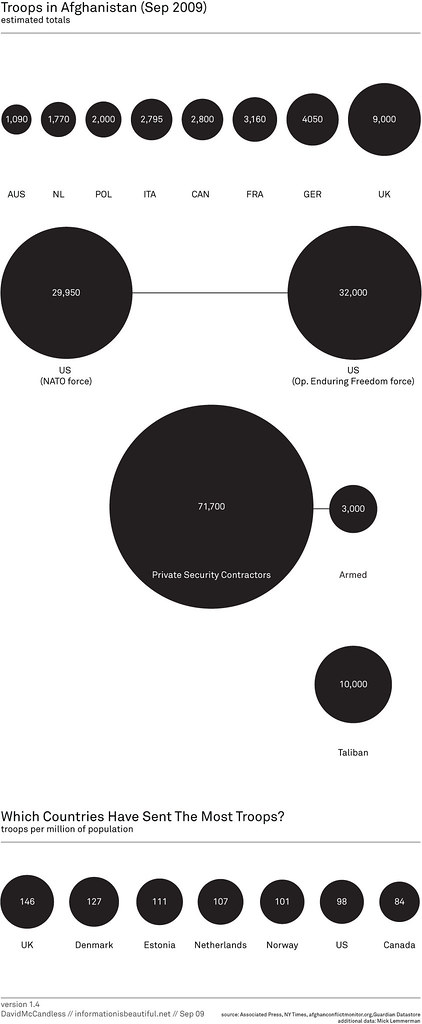
Information is Beautiful posted a couple of interesting graphics recently.

The Billion Dollar Gram is a shocking visual of govt waste. The picture seems self explanatory, so I won't comment further.

The second graphic that caught my eye was the third of the Four Infographic Morsels. A small version is below. A larger version can be seen by clicking the image, clicking the blog link above and scroll down, or click http://farm3.static.flickr.com/2595/3941254968_7f70fbd209_b.jpg.


Afghanistan, the graveyard of empires, outnumbered 9 to 1 (16 to 1 if include all private security contractors) is kicking the USG's ass. Unfortunately Obama is too stupid to learn from history.

Friday, September 18, 2009

Next Meeting

The next meeting is scheduled for:

Tuesday September 22, 2009
5:30ish to 8:00 pm

Panera Bread
28551 Schoolcraft Road
Livonia, Michigan

Discussing chapter 10 of America's Great Depression and Scott Horton's interview of Daniel Lakemacher and if there's interest, a related interview with Adam Szyper Seibert.

Chapter 10: 1931-"The Tragic Year"


http://antiwar.com/radio/2009/09/16/daniel-lakemacher
Scott Horton Interviews Daniel Lakemacher
September 16, 2009

Daniel Lakemacher, founder of the website WarIsImmoral.com, discusses his conscientious objector (CO) discharge from the U.S. Navy, how the experience of working at Guantanamo and (independently) learning about the libertarian “non-aggression principle” changed his mind about war and justice, the process of becoming a CO and how the military defines morality in terms of obedience/disobedience.

MP3 here. (25:03)

Daniel Lakemacher was discharged as a conscientious objector from the U.S. Navy on 09/11/09. He is the founder of the website WarIsImmoral.com


http://antiwar.com/radio/2009/09/12/adam-szyper-seibert/
Scott Horton Interviews Adam Szyper-Seibert
September 12, 2009

Adam Szyper-Seibert, counselor and office manager at Courage to Resist, discusses Lt. Ehren Watada’s successful resistance to an Iraq deployment, the year-long waiting list for treatment at the VA, the fraternal bonds that keep reenlistment rates high, increased military success (since WWII) in training soldiers to be hate-driven killers and the “Ft. Bragg 50″ who are held without charges in degrading conditions.

MP3 here. (38:01)

Adam Szyper-Seibert is a counselor and office manager at Courage to Resist, an organization that provides support to military resisters.

Wednesday, September 9, 2009

"Solidarity forever"

You may have heard that Oakland University's professors have been on strike since last Thursday, when classes were supposed to start. Among their demands is an 11% pay raise over the next 3 years.

Here is fantastic video of one of the rallies, complete with song and dance. Check out the "stop administration dictatorship" sign.

Tuesday, September 8, 2009

Stock Charts: 1929 & 2009

Rothbard starts chapter nine of America's Great Depression stating, "By early 1930, people were generally convinced that there was little to worry about." The news today is filled with positive stories about unemployment, housing, and economic recovery as if there is little to worry about. So I went to find some stock charts comparing the past few years with the 1930s. Though I'm sure I've seen some overlayed charts in the past, I couldn't find any. If you know of any, please post a link. Here are some charts I found to which I compared current charts from bigcharts.com.

The first one, from http://www.online-stock-trading-guide.com/1930-stock-chart.html, shows 4 1/2 years of the DJIA from Oct 1928 to March 1933. That is one year prior to the 29 crash until the bottom of the market in 33. In comparison is a chart of the last 3 years from BigCharts. This is a little more than one year prior to the start of the current depression. This makes the relative starting points of the two charts a little off but fairly close. We haven't transgressed 3 years into the recession, so the current chart is of shorter duration.


The second set of charts compares 1930 (once again from http://www.online-stock-trading-guide.com/1930-stock-chart.html) to 2008. The stock market crash occurred in October 1929, a couple months after the Great Depression began. The current recession supposedly began in December 2007. Thus, 1930 is the first full year of the Great Depression and 2008 is the first full year of the current depression.


The last set of charts compares the period of 1924 to 1933 to the past decade of 1999 to 2009. The 1924 to 1933 chart is duplicated in numerous places on the web, but I pulled it from http://www.gold-eagle.com/editorials_01/seymour062001.html. The circles refer to quotes listed in the article at gold-eagle.com. If you haven't seen the article before, click through for a good read.


If we overlaid the second chart starting in 2003 onto the first chart starting at 1925, it looks like there would be strong similarity.

While trying to find charts, I came across one other interesting comparison. From Numbers From the Wasteland, here is
current unemployment to unemployment in the 20s & 30s.
If you have any other good comparisons or better charts, please post.

Friday, September 4, 2009

Unemployment continued.

Vice President Biden opened his mouth yesterday to state that the stimulus was improving "the trajectory of our economy" (VOA).

He also stated, "The Recovery Act is doing more, faster and more efficiently and more effectively than most people expected" (AP).

July's unemployment numbers are showing how well the stimulus plan is "working".

The percentage of unemployed workers is going up, yet again. July's percentage is 9.7% of the work force is not employed. An overall increase of .3% unemployment between June and July.

Thursday, September 3, 2009

Interview

I haven't listened to this yet but it looks like it discusses whether the left retains its anti-war energy when there is a Democrat president: http://www.lewrockwell.com/blog/lewrw/archives/34788.html

Monday, August 31, 2009

Retirement Accounts

Lately I've been wary of retirement accounts because:

- they may be taken over by the government by the time I retire
- due to inflation the money could be worth very little by the time I retire

For these reasons I closed out my account (tax penalty and all) when I quit my last job and did other things with that money.

I planned to not start a 403(b) ever again.

However, one of the places I am working is offering a double match. If I contribute 5% of my salary, they contribute an additional 10%. That is a lot of money and it is tempting. However, I resent the fear-mongering ("you need over 2 million dollars to retire") and bad financial advice ("markets always go up") given by the shady sales people that work for these companies.

Right now I am leaning toward opting out, but the 10% is pulling me back in. To be eligible for a double match from the school, I'd have to enroll by the end of September.

With the assurance that I in no way hold you responsible for what I decide, does anyone have any thoughts or advice on this?

Choices offered (I don't fully understand what these mean):

From TIAA-CREF
- Multi-asset - mutual fund
- Equities - variable annuity and mutual fund
- Real estate - variable annuity
- Fixed income - variable annuity and mutual fund
- Money market - variable annuity and mutual fund
- Guaranteed - guaranteed annuity
- NO LOANS

From Fidelity
- "Freedom fund" - mutual fund, seems to have no employee freedom, Fidelity chooses allocations
- "Money market trust"
- Not sure what else; didn't give much information
- NO "SELECT" PORTFOLIOS including gold, energy, etc.

Update: the "select" sector funds ARE being added to Fidelity's options starting in January

Thursday, August 27, 2009

Unemployment Rate.

The Feds are claiming the current unemployment rate is 9.4%. Several articles have popped up in the last few months contesting the claim of 9.4% unemployment. These articles are stating the real percentage is closer to 16% and could be as high as 20% nationally. Finally, Detroit is once again number one for something; and an unemployment rate of 28.9% is NOT something to be proud of.

Below you will find three articles, the first two relate to the national number, while the latter article is just the city limits of Detroit.

John Miller wrote in the Dollar and Sense article that the true adjusted rate is 16.4%.

Anthony Mirhaydari's article on MSN money states the unemployment rate to be closer to 20%.

The Detroit Free Press has a strong and viable number for the City of Detroit's percentage to be at 28.9%

One last note, I was surprised the Detroit unemployment number is not closer to a 1/3 of the population.

Next Meeting

The next meeting is scheduled for:

Tuesday September 8, 2009
5:30ish to 8:00 pm

Panera Bread
28551 Schoolcraft Road
Livonia, Michigan

Discussing chapter 9 of America's Great Depression and Scott Horton's interview of Cindy Sheehan. We may include a brief discussion of chapter 8 due to some confusion regarding assigned chapters at the last meeting.

Chapter 8 - The Depression Begins: President Hoover Takes Command
Chapter 9 - 1930


Today Scott Horton interviewed Cindy Sheehan. I haven't heard anything from Cindy in a couple years and had no idea that Camp Casey had been set up in Martha's Vineyard during Obama's vacation. The description seems to indicate that Sheehan, a leftist, is criticizing other leftists for their complete lack of integrity. Sounded interesting, so I have chosen it for the AWR interview for the next meeting.

http://antiwar.com/radio/2009/08/27/cindy-sheehan
Scott Horton Interviews Cindy Sheehan

Scott Horton, August 27, 2009

Peace activist Cindy Sheehan discusses how to keep the antiwar movement alive during a Democratic presidency, the activist groups willing to trade integrity for Washington access, the universal right to life and liberty and Camp Casey’s move to Martha’s Vineyard during Obama’s vacation there.

MP3 here. (17:31)

Cindy Sheehan became a leader of the antiwar movement after her son, Casey, was killed in Iraq. Her efforts to get answers from President Bush, including a vigil in Crawford,Texas, have received national media attention. She has a website, is the author of Peace Mom: A Mother’s Journey through Heartache to Activism and wrote the introduction to 10 Excellent Reasons Not to Join the Military.